A Day in Silicon Valley
Notes from the first day of Tech Trek 2016
6:30 AM, commotion
The first yawns of what will be a long day. After a round of “Buen día”, “Buongiorno”, and “Good morning”, and with the help of some coffee, the senses start to keep pace with what’s ahead.
7:15 AM, highway
Only a few kilometers separate us from Emergence Capital, a venture firm that has an Argentine among its main figures, Santiago, who not only welcomed us with open arms, but also put all his knowledge at our disposal.
Emergence Capital, a long conversation.
Around a large oak table, Santiago tells us about his beginnings — about that young entrepreneur who, day after day, did what he knew how to do best: sell. Early on, together with Armando Mann, they built an e-learning platform that, despite surviving the economic crisis of 2001, they decided to take to the United States. That’s where a major opportunity came knocking, and they sold the company. A new one was already taking shape: an MBA at Harvard.
“One of the best decisions of my life was doing the MBA.”
Santiago said, describing the friendships and relationships he took from it. Later he focused on venture capital, and that’s when our eagerness to understand how it works led to a few questions. One stood out:
- What are the main differences between a startup in Buenos Aires and one in Silicon Valley?
“It’s important to understand that every decision inside a venture capital firm is decisive for the company, because choosing to invest — or not — in a startup could be what allows it to become a billion-dollar company. That doesn’t happen in the same way in Buenos Aires, where there’s a kind of bootstrapping — tying things together with wire — for lack of capital, and where the company’s vision, on a global scale, stays small.”
The day is only getting started
After an exchange of ideas, with an economic slant, we picked the trip back up with a visit to the well-known Korean company Samsung. Irene was waiting for us, playing with a dog from her wide desk and greeting us with a big smile; we immediately got a sense of the culture behind the company. We took a trip through time, learning its history and how it had adapted to the different contexts it faced. After a wide-ranging discussion that went from chips to virtual reality, we headed to Samsung’s large park in Roseville for lunch. The conversation became more personal, and we learned Irene’s story, and how closely she identified with the company she works for.
From the park to the lab
We said goodbye to Irene in the sunny garden, and a few meters later we ran into a major biotechnology company, DuPont. Walking into the labs, you could have mistaken it for a laundry: around 30 washing machines, with water at different temperatures, capacities, colors, and brands, testing the effectiveness of enzymes that will go into cleaning products. At first glance you might think the products are made there, but they aren’t. It’s a large laboratory that develops different enzymes by altering amino acids, which large companies then buy to produce at scale. After the tour, a mocha was waiting for us at the bar, to share our view of the company and what it’s actually like — which, as it happens, feels like a large family.
One last adventure to close the day: Amazon
Even though the day had already been intense, we still had energy for one last stop. In a large grove of tech buildings stand the three most imposing ones in the area, which belong to Amazon. Damián, a security manager with twelve years at Microsoft, welcomed us, and we were able to draw a deep comparison between the two companies. Amazon’s culture is built around facing problems quickly, where getting it wrong is a tool for learning, used with the sole aim of growing. Even with the exponential pace this kind of approach allows, there is a structure that prepares people to be ready. Given that Amazon is the leader in delivery, will this be the methodology many companies end up adopting?
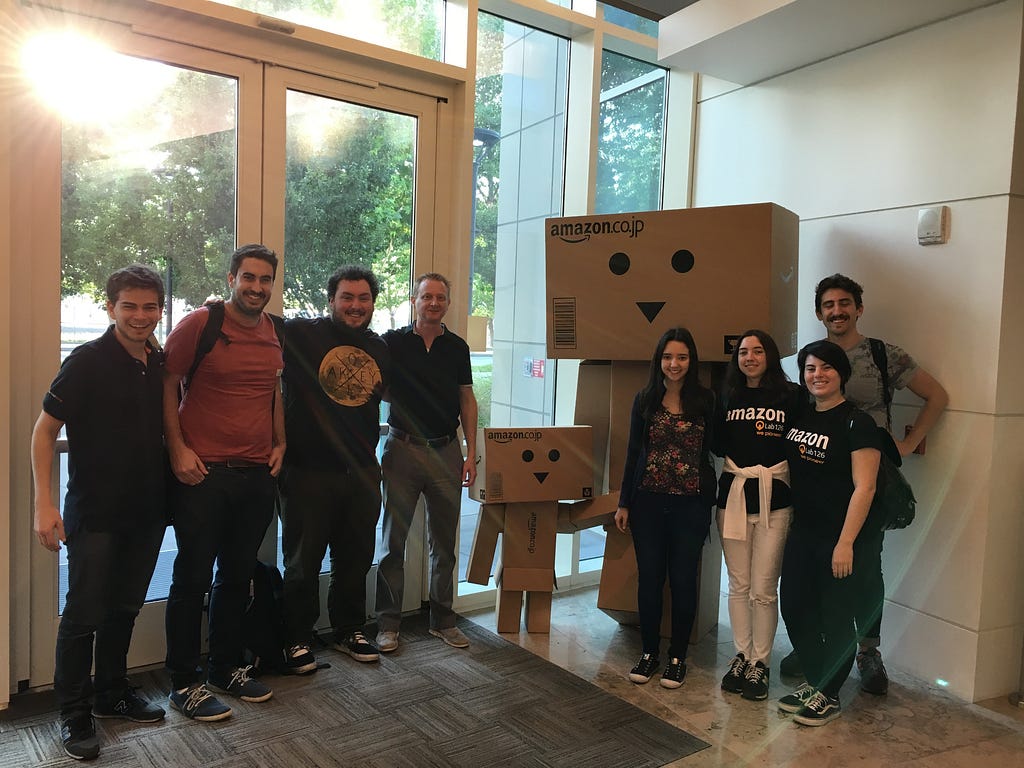
The Tech Trek team with Damián, Head of Information Security at Amazon.