AI Agents: My First Mission

I never thought I’d end up managing a group of autonomous agents with their own initiative, no filters, and zero sense of limits. But here I am: new site live, code deployed, and that weird feeling of not knowing if I did something brilliant… or if I just played with fire and got lucky.
It all started with the idea of giving my portfolio site a fresh look. I already had a previous version: functional, neat, with clear content. But it didn’t really convey what I wanted to show. I wanted the design to speak for me, to better reflect my style and personality, without having to rewrite everything from scratch or launch a long, complex project.
I was aiming for a restyling that was quick but meaningful, that brought freshness without losing essence. And that’s when I asked myself:
What if I tackled this redesign as a project guided by AI agents?
It wasn’t about delegating everything. It was about directing. Setting up a kind of virtual creative studio, where I provided the big picture and the agents helped me execute, propose, and iterate.
Translating a feeling into prompts, deciding between styles I couldn’t even name, tweaking small details so the result felt truly mine. That was the real work.
Exploring Creative Chaos
Once the general idea was set, it was time to give the redesign its face. But, as with any AI project, it didn’t start with traditional sketches or wireframes. I began with moodboards and visual references, browsing Dribbble, Behance, and other places where design really breathes.
The challenge was to express what I wanted to convey, even without having the exact words to define it. In my head, styles like glassmorphism, neobrutalism, and classic minimalism were mixing, each with their own rules, risks, and opportunities. AI was key to translating that fuzzy feeling into concrete proposals: color palettes, typography combinations, and layouts I could review and adjust.
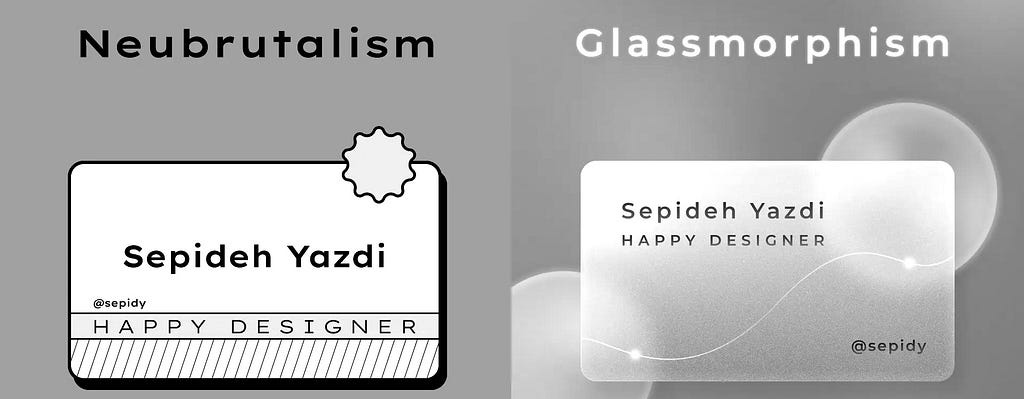
Credits to Sepideh Yazdi
I quickly realized this wasn’t a linear process: it was all about showing, correcting, and tweaking constantly. For this to work, I had to get clearer with my prompts and, above all, learn to trust the process a bit.
There were plenty of “rollbacks”, prompts that produced absurd results or designs that just didn’t click, shifts in direction, and a lot of trial and error. But this constant need to clarify ideas ended up being more valuable than I expected.
Translating an abstract feeling into clear words was the hardest and most meaningful part of the whole process.
Iterations, Mistakes, and Lessons Learned
What surprised me most working with AI agents was the speed: in minutes, you get prototypes, texts, entire palettes. But that same speed can also backfire.
A poorly formed prompt doesn’t just yield mediocre results: it can flood the design with a thousand unnecessary elements, like the AI is trying to do everything at once. Or at the other extreme, reduce everything to empty minimalism, as if the site was frozen on a blank screen.
The key was understanding that AI doesn’t guess: it reflects. And it reflects with brutal honesty. If you don’t give it a clear instruction, it’ll hand you a mess. So I had to do several rollbacks, refine and polish prompts over and over.
This process forced me to translate abstract sensations into precise instructions. And that’s no small thing: it’s an exercise in self-awareness, mental clarity, and communication.
The craziest thing was realizing these agents do something we usually think of as human: getting to the root of the problem. But they do it in reverse. While humans asks questions, investigates, and tries to understand the core issue, AI just shows you the error outright it reflects the vagueness or mistakes in your prompt without sugarcoating.
These agents are both a mirror and a multiplier. They faithfully reflect what you give them and amplify both the good and the bad. Give them clear instructions, and they multiply value; if not, they multiply chaos.
That unfiltered mirror was the best coach I could have had to sharpen not only my communication with AI, but also how I think, analyze, and translate fuzzy ideas into concrete solutions. Beyond technology, this experience taught me to see myself as a communicator and translator, not just a technician.
And that shift in perspective was, for me, the most valuable takeaway of all.
Final Thoughts
Managing AI agents taught me that this isn’t just about automation; It’s a new way of thinking and collaborating. AI reflects your clarity (or lack of it) back at you, pushing you to be precise and intentional.
More than a tool, these agents are partners that challenge and sharpen your creativity. This journey was a reminder: behind every technology, there’s a human story and a spark to create something meaningful.
If you’re diving into AI agents, embrace the chaos, trust the process, and be ready to learn from both the machines and yourself.